The Gateway Between Worlds

The Missing Altar

I’ve always had an elaborate ancestral altar in my home. I like to do it up proud—bells and whistles, teacups, bits of jewelry, and the poetry my mother wrote. It always gets extra attention around Samhain, and we’re almost at that threshold again.

Last Samhain, the photos and mementos were lined up on the kitchen table, waiting to be arranged. But due to unforeseen circumstances (I still don’t know what they were), the altar didn’t make it in our cross-country move. It exists somewhere between houses and miles, or who knows maybe it’s residing in some picturesque place on the other side. Thankfully, the photos and small sacred things survived the journey.

Yet absence, I’ve learned, is also an altar. It asks you to begin again.

The missing ancestral altar feels like one of those living metaphors the universe gifts us, a reminder that what we honor doesn’t vanish, it migrates, it shapeshifts, it makes room for something else.

Last year I wasn’t up to building another, but this year, with my daughter and grandson home, it feels right. I’m excited over gathering wood and paint and preparing the ancestors for their new dwelling. We’ll build again and fill the space with what remains and what’s been reborn, photographs, bits of jewelry, and the scent of cookies cooling on the counter. The ancestors will find it. They always do.

A Glimpse into my novel, Thistle Bay.
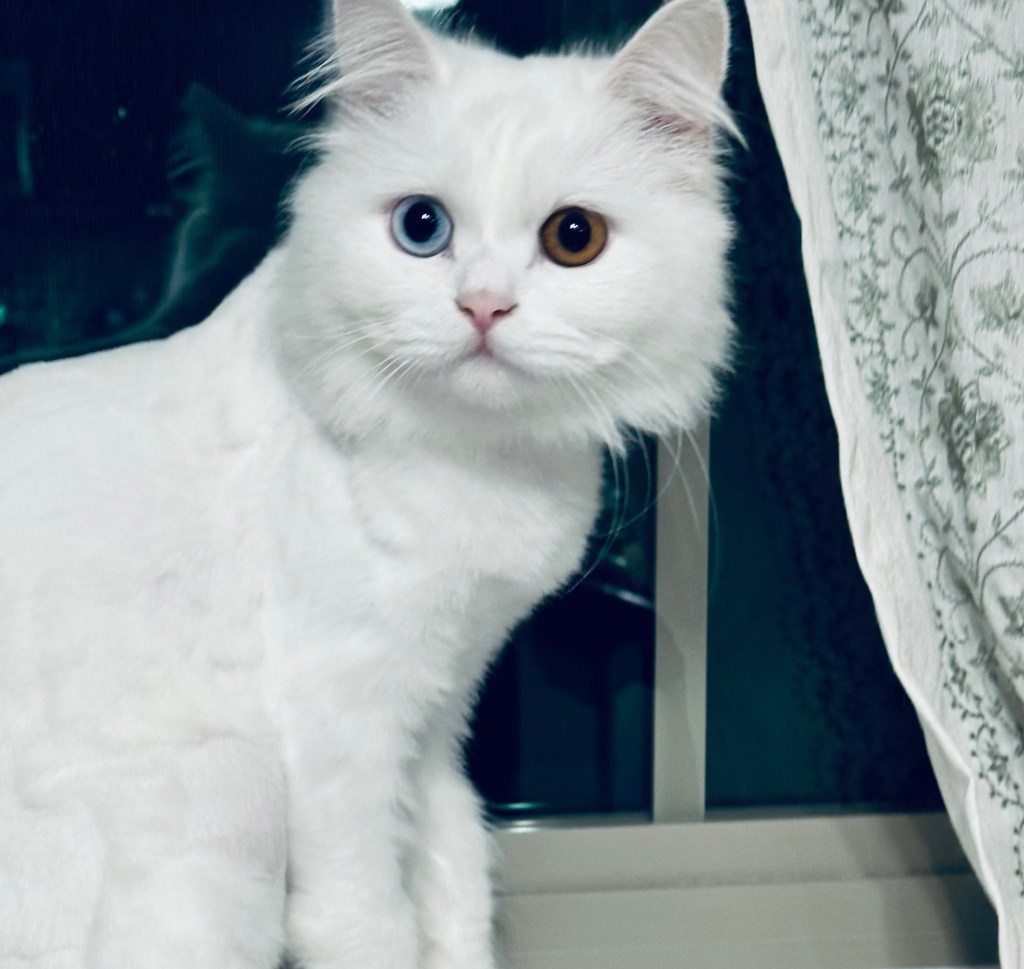

Meet Bones, the white-as-moonlight familiar who guards the garden gates of Thistle Bay and my own hearth alike.
He has one eye on the living & one on the departed.

The following isn’t a scene from the book, but it does offer a window into the world of Thistle Bay and its inhabitants.

Star watched as the fog unrolled itself over the yard, soft as unspun wool. The bells in the ash tree began their small dance, rising and falling like breath. She looked toward the orchard and nodded at the realization that it was almost Samhain again—the turning hinge of the year when the living and the dead lean toward one another and listen.

Bones, the year-old cat, white as moonlight, had appointed himself Keeper of the Threshold, Guardian of the Hearth. He is an unusual hybrid, one part Maine Coon, one part Persian, born in Russia, lived in Egypt for nine months, and somehow landed on First Street in Thistle Bay. His weathered passport, complete with shot records, was tied around his neck with a frayed ribbon when he appeared. He headed straight for the B&B and never left.

Bones arrived just a few days before Star, a quiet herald of her coming, though no one put two-and -two-together. When Wren spotted him on the property, she claimed him instantly. He has one blue eye and one amber. Wren insists the blue sees this world, while the amber gazes into the next. Though young, Bones carries himself like an old, salt-worn seafarer.

Each dawn he pads through the garden, his pom-pom tail flicking like a snow-covered branch as he makes slow rounds through the cat graveyard. He brushes against each cross as though waking old friends, then settles by the Brighid altar covered in stones, beach glass, rosemary sprigs for remembrance and a single votive trembling in its glass.

When the fog thickens, it’s hard to tell where the world ends and the veil begins.

Inside, Star bakes rosemary remembrance cookies for the ancestors. The scent threads through the open window and out into the mist, like an offering.

Folklore says rosemary keeps the memory of the dead close, its smoke calling them home gently. I like to imagine the fragrance finding Bones, and curling around him like an ancestral shawl.

Does anyone else keep an ancestral altar? What always finds its way onto yours?

Ink and Incantations.

There are books we love that seem to haunt us long after we’ve closed the covers. For me, those books have always lived in the strange and beautiful space I now call lyrical magical fiction, stories that blend the ordinary and the mystical in quiet, poetic ways.

Not fantasy.
Not sci-fi.
Not vampires or alternate planets.
Just this world but shimmering slightly.

A teacup that knows your secrets.
A tree that blooms when someone is healed, no matter the season.
A ghost that doesn’t apologize for showing up at breakfast.

I’ve loved stories like that my entire life. What I didn’t realize until very recently is, I also enjoy writing them. At 66, I’m finally giving myself permission to write the way I see the world. To trust that my own strange blend of poetry, intuition, spirituality, and myth has a place.

Lyrical magical fiction has offered me a creative home I didn’t even know I was longing for. I came to it sideways. When I began writing about my adoption, something unusual happened.
I imagined what my deceased biological mother might say to me, if she could. And her voice came through, clear, poignant, full of mystery. I didn’t know I was walking through the veil into the realm of the mystical. I only knew that the conversation felt true. And healing. And necessary.

That’s the thing about this kind of storytelling, it doesn’t ask you to explain the unexplainable. It just asks you to believe it for the span of a sentence. A page. A life. It lets me braid together all the parts of myself, my lifelong love of poetry, spiritual practices and devotional paths and the houses I’ve lived in, 52, and the ones that still live in me.

It affirms my experience as an adoptee, a seeker, a writer, an intuitive, and a woman who sees no boundary between the sacred and the everyday.

The teacup is an altar.
The garden is a prayer.
The page is a portal.

I’ve often said, I see the world through a witch’s eyes.
And honestly? I’m still stunned it took me this long to figure out my voice. I remember wanting to write fiction in undergrad but didn’t. It surfaced again in my MFA program at Goddard, whispering at the edges. But I told myself I needed to use my platform for more “important” things, to address oppression, grief, all the endless woes of the world. 

The truth is those themes can be woven into the fabric of my work if I choose. And I don’t have to suffer to write something meaningful. I still remind myself, it’s okay if I enjoy the writing process.

I’ve healed so much by writing about adoption, by facing it head-on. I no longer feel the need to circle it endlessly. That doesn’t mean it won’t show up in my fiction. It might.
But it will arrive in different forms, under different names.

I’m still deeply engaged in the world. I’ll always be that way. But I also trust now that wonder is as vital as witness.Beauty is not an escape it’s a kind of activism. Maybe I had to live enough years to understand how grief walks beside wonder. How the sacred hides in ordinary dust. How our stories aren’t always linear.

They spiral.
They haunt.
They heal.

But there’s more I need to say.

Last night, I woke from a dream that brought everything into focus.

I understood, in that soft, in-between place, why I write this way.
Why I string words together like spells.
Why mood and setting matter so much—because they are incantations.
A way of shaping how I see and feel and breathe.

I write like this because I’m trying to understand the world.

How to keep seeing beauty, even when everything feels broken.
How to hold grief and magic in the same palm.
How to live honestly in a world full of sorrow and still look for the shimmer.

Writing, for me, is both resistance and reverence.
A way to say, yes, this world is unraveling and yet,

There is still wonder.
There is still mystery.
There is still a ghost at the breakfast table, and a tree that blooms when someone forgives.

That’s what lyrical magical fiction offers me,
Not escape.
But a way to live with everything.
To bear witness and bless.

It challenges me.
It stretches me.
But more than anything, it heals me.

Are you drawn to stories like this too?
Have you ever written something you thought was “just a story,”
only to discover it held a spell, a prayer, or a sacred truth?

I’ll be sharing more about this journey in the coming weeks, craft notes, prompts, book recommendations, and lessons I’m learning as I write my novel.

But for now, I just want to say:

If you see the world a little differently,
If you talk to ghosts or believe that houses can feel,

You’re not alone.
You’re not wrong.
You might just be a writer of lyrical magical fiction.
Or maybe, like me, you always were.