The Gateway Between Worlds

The Missing Altar

I’ve always had an elaborate ancestral altar in my home. I like to do it up proud—bells and whistles, teacups, bits of jewelry, and the poetry my mother wrote. It always gets extra attention around Samhain, and we’re almost at that threshold again.

Last Samhain, the photos and mementos were lined up on the kitchen table, waiting to be arranged. But due to unforeseen circumstances (I still don’t know what they were), the altar didn’t make it in our cross-country move. It exists somewhere between houses and miles, or who knows maybe it’s residing in some picturesque place on the other side. Thankfully, the photos and small sacred things survived the journey.

Yet absence, I’ve learned, is also an altar. It asks you to begin again.

The missing ancestral altar feels like one of those living metaphors the universe gifts us, a reminder that what we honor doesn’t vanish, it migrates, it shapeshifts, it makes room for something else.

Last year I wasn’t up to building another, but this year, with my daughter and grandson home, it feels right. I’m excited over gathering wood and paint and preparing the ancestors for their new dwelling. We’ll build again and fill the space with what remains and what’s been reborn, photographs, bits of jewelry, and the scent of cookies cooling on the counter. The ancestors will find it. They always do.

A Glimpse into my novel, Thistle Bay.
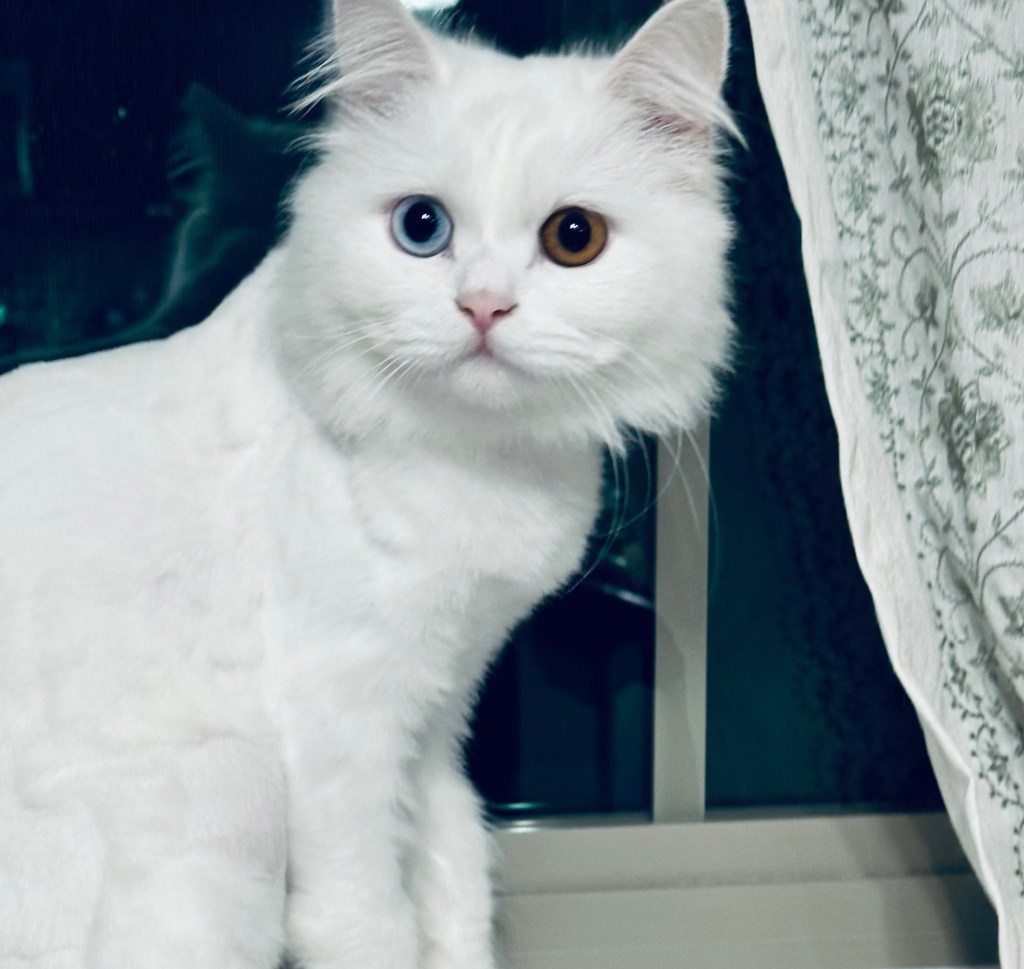

Meet Bones, the white-as-moonlight familiar who guards the garden gates of Thistle Bay and my own hearth alike.
He has one eye on the living & one on the departed.

The following isn’t a scene from the book, but it does offer a window into the world of Thistle Bay and its inhabitants.

Star watched as the fog unrolled itself over the yard, soft as unspun wool. The bells in the ash tree began their small dance, rising and falling like breath. She looked toward the orchard and nodded at the realization that it was almost Samhain again—the turning hinge of the year when the living and the dead lean toward one another and listen.

Bones, the year-old cat, white as moonlight, had appointed himself Keeper of the Threshold, Guardian of the Hearth. He is an unusual hybrid, one part Maine Coon, one part Persian, born in Russia, lived in Egypt for nine months, and somehow landed on First Street in Thistle Bay. His weathered passport, complete with shot records, was tied around his neck with a frayed ribbon when he appeared. He headed straight for the B&B and never left.

Bones arrived just a few days before Star, a quiet herald of her coming, though no one put two-and -two-together. When Wren spotted him on the property, she claimed him instantly. He has one blue eye and one amber. Wren insists the blue sees this world, while the amber gazes into the next. Though young, Bones carries himself like an old, salt-worn seafarer.

Each dawn he pads through the garden, his pom-pom tail flicking like a snow-covered branch as he makes slow rounds through the cat graveyard. He brushes against each cross as though waking old friends, then settles by the Brighid altar covered in stones, beach glass, rosemary sprigs for remembrance and a single votive trembling in its glass.

When the fog thickens, it’s hard to tell where the world ends and the veil begins.

Inside, Star bakes rosemary remembrance cookies for the ancestors. The scent threads through the open window and out into the mist, like an offering.

Folklore says rosemary keeps the memory of the dead close, its smoke calling them home gently. I like to imagine the fragrance finding Bones, and curling around him like an ancestral shawl.

Does anyone else keep an ancestral altar? What always finds its way onto yours?
The Voice Beneath the Voice

When Silence Flattens a Character (and a Life)

I am finishing up my summer intensive fiction program, and I have thoroughly enjoyed this three-month journey. I have an MFA, but not in fiction. My work has mostly been memoir, nonfiction, and hybrid pieces.

I decided to jump genres and try something new—something I always wanted to do but didn’t. I was going down a certain path and didn’t want to muddy the waters. I wasn’t sure how to turn back, even though there was an underlying and not so silent current, trying to alert me I wasn’t where I wanted to be.

During my summer class I discovered how much I adore magical realism with its lyrical bend that draws out the poet in me. Creating scenes and characters and adding magical elements to everyday life has caused me to fall in love with writing all over again. I’ve added spells, recipes, ancestral ghosts that share wisdom, humor, and sometimes a bit of pot stirring.

I have given voice to all the aspects of myself, and I finally feel at home with my writing. I’ve found my voice, and my writing has taken a big leap. I think it’s because I am excited to learn.

My memoir was about healing my adoption issues. It was raw and necessary. It wasn’t time wasted, but I am grateful to be where I am now. For the first time, I feel in right relationship with my writing.

My novel is at the halfway point, and the pressure is on the main character to either shy away in despair or rise to the occasion.

This weekend I reread everything I’ve written so far, and I realized the main character had become paper-doll like. Flimsy. She had the outline of a person, but without the spark that makes her real.

It wasn’t the plot. It wasn’t the setting. It was her silence.

I hadn’t given her enough inner life on the page, her thoughts, her contradictions, the way she second-guesses herself before she dares to speak. Those elements were missing. So, I went back in, and instead of fussing over description or dialogue tags, I started weaving in the voice beneath her voice. The words she doesn’t say out loud but that still shape every choice she makes.

Thankfully, I was able to take her off life-support.

This process forced me to stop and think, what if our real lives worked that way too? Imagine if our internal dialogue, the loops of doubt, hope, memory, and secret joy were spoken aloud. Would we shock people with our honesty? Would we connect more deeply, or burn more bridges?

So often, the world hears our “edited” version. Polished, polite, or pared down to what feels safe. Meanwhile, our inner voices are weaving epics no one else ever hears.

I discovered how important it is to let those hidden voices out, at least on the page.

We live in two worlds, the inner and the outer. The one where we tell ourselves the truth, and the one where we offer the softened version. When those two worlds drift too far apart, things get brittle. And yet, when they line up too closely, we risk being raw and unguarded.

Is it possible that the healthiest thing isn’t to match them perfectly, but to let them remain in dialogue with each other?

Maybe the trick is not to silence that voice, but to give it room. In writing. In journaling. And sometimes in conversation, when we feel safe. I think it’s important to pause often and consider how our inner world aligns with our outer and adjust as needed.

Adding internal dialogue brought my character back to life. And maybe that’s the lesson, whenever we feel flat, whether in a draft or in ourselves, it’s often because we’ve lost touch with the voice inside. The one that stumbles, rambles, contradicts, questions, and dreams. The one that makes us whole.

Writing Prompt

Think of a moment when your “outer voice” said one thing, but your “inner voice” whispered another. Write a short scene capturing both.

Choose one of your characters and let them spill their inner dialogue onto the page without editing. How does this shift your sense of who they are?

  Reflect on your own life: when does your inner voice feel most aligned with the outer? When does it feel most at odds?

Sensory Sorcery for Lyrical Writers.

Since I am writing a magical novel, I am using more lyrical language than usual in my prose. I am also a huge fan of poetry—both reading and writing. I love lyrical language. I am using it to world-build, create scenes, describe the landscape and the mood. I naturally have a bit of a lyrical bend to my work, but I wanted to push things a bit, so I created some basic exercises for myself. One of the exercises I am doing is the following:

Prompt: Describe a doorway 3 ways: enchanted, threatening, sacred. The key is to engage all the senses. The following is a brief example of my sacred door attempt. 

At the end of a narrow, cobblestone street, tucked between cracked buildings The relentless noise of the traffic, and laundry lines, there is a small ashram almost hidden, as if the city itself had forgotten it. The doorway is low and crooked. Faded pots hold murky water and pink lotus buds, guardians of the narrow steps. Someone has scattered rose petals and marigolds across the threshold. I pause at the entrance and take a deep breath, inhaling the scent of flowers and gasoline—an attempt at shaking off the city.

Sight Example: Teacups drying on a towel in the kitchen though no one has used them today.

Sound: The faint whoosh of wind down the chimney, carrying the scent of saltwater.

Smell: A faint perfume lingering in the hallway — not current, but like it’s soaked into the wallpaper.

Touch: Smooth banister worn satiny by decades of hands.

If anyone feels like sharing or discussing their writing process, I would love to hear from you. 

Ink and Incantations.

There are books we love that seem to haunt us long after we’ve closed the covers. For me, those books have always lived in the strange and beautiful space I now call lyrical magical fiction, stories that blend the ordinary and the mystical in quiet, poetic ways.

Not fantasy.
Not sci-fi.
Not vampires or alternate planets.
Just this world but shimmering slightly.

A teacup that knows your secrets.
A tree that blooms when someone is healed, no matter the season.
A ghost that doesn’t apologize for showing up at breakfast.

I’ve loved stories like that my entire life. What I didn’t realize until very recently is, I also enjoy writing them. At 66, I’m finally giving myself permission to write the way I see the world. To trust that my own strange blend of poetry, intuition, spirituality, and myth has a place.

Lyrical magical fiction has offered me a creative home I didn’t even know I was longing for. I came to it sideways. When I began writing about my adoption, something unusual happened.
I imagined what my deceased biological mother might say to me, if she could. And her voice came through, clear, poignant, full of mystery. I didn’t know I was walking through the veil into the realm of the mystical. I only knew that the conversation felt true. And healing. And necessary.

That’s the thing about this kind of storytelling, it doesn’t ask you to explain the unexplainable. It just asks you to believe it for the span of a sentence. A page. A life. It lets me braid together all the parts of myself, my lifelong love of poetry, spiritual practices and devotional paths and the houses I’ve lived in, 52, and the ones that still live in me.

It affirms my experience as an adoptee, a seeker, a writer, an intuitive, and a woman who sees no boundary between the sacred and the everyday.

The teacup is an altar.
The garden is a prayer.
The page is a portal.

I’ve often said, I see the world through a witch’s eyes.
And honestly? I’m still stunned it took me this long to figure out my voice. I remember wanting to write fiction in undergrad but didn’t. It surfaced again in my MFA program at Goddard, whispering at the edges. But I told myself I needed to use my platform for more “important” things, to address oppression, grief, all the endless woes of the world. 

The truth is those themes can be woven into the fabric of my work if I choose. And I don’t have to suffer to write something meaningful. I still remind myself, it’s okay if I enjoy the writing process.

I’ve healed so much by writing about adoption, by facing it head-on. I no longer feel the need to circle it endlessly. That doesn’t mean it won’t show up in my fiction. It might.
But it will arrive in different forms, under different names.

I’m still deeply engaged in the world. I’ll always be that way. But I also trust now that wonder is as vital as witness.Beauty is not an escape it’s a kind of activism. Maybe I had to live enough years to understand how grief walks beside wonder. How the sacred hides in ordinary dust. How our stories aren’t always linear.

They spiral.
They haunt.
They heal.

But there’s more I need to say.

Last night, I woke from a dream that brought everything into focus.

I understood, in that soft, in-between place, why I write this way.
Why I string words together like spells.
Why mood and setting matter so much—because they are incantations.
A way of shaping how I see and feel and breathe.

I write like this because I’m trying to understand the world.

How to keep seeing beauty, even when everything feels broken.
How to hold grief and magic in the same palm.
How to live honestly in a world full of sorrow and still look for the shimmer.

Writing, for me, is both resistance and reverence.
A way to say, yes, this world is unraveling and yet,

There is still wonder.
There is still mystery.
There is still a ghost at the breakfast table, and a tree that blooms when someone forgives.

That’s what lyrical magical fiction offers me,
Not escape.
But a way to live with everything.
To bear witness and bless.

It challenges me.
It stretches me.
But more than anything, it heals me.

Are you drawn to stories like this too?
Have you ever written something you thought was “just a story,”
only to discover it held a spell, a prayer, or a sacred truth?

I’ll be sharing more about this journey in the coming weeks, craft notes, prompts, book recommendations, and lessons I’m learning as I write my novel.

But for now, I just want to say:

If you see the world a little differently,
If you talk to ghosts or believe that houses can feel,

You’re not alone.
You’re not wrong.
You might just be a writer of lyrical magical fiction.
Or maybe, like me, you always were.

How I Fell into Fiction (and Landed in a Haunted Orchard)

Wild Thistle is the wild place within—where I write from. It’s about the roots, the ritual, the remembering.

 I’ve been working on what I call a Lyrical Magical Fiction/Witchy novel for a stretch of time. It’s something I have wanted to do for decades. I was reluctant to give myself permission to switch genres and worked hard at keeping that part of myself silenced.  I was/am a memoir and non-fiction writer that sometimes wrote poetry. 

To my great surprise (and slight existential whiplash), I love creating characters and building witchy, enchanted worlds. It’s changed everything. I now write from the same intuitive space I enter when reading Tarot—a quiet place where I listen, wait, and follow the strange thread that shows up. With Tarot, I uncover the story inside the cards. With my novel, I uncover the story inside me.

My current work-in-progress is called Thistle Bay: Where the Cat Bones Sing. It’s got a magical house, a haunted orchard, and women who know their way around herbs, heartbreak, and hexes. Each morning, I show up curious to see what the characters are up to and whether they’ve gone and started a séance in the garden without telling me.

I’m enrolled in a summer long intensive fiction writing class and hope to have a strong 2nd draft completed by late August.

Switching genres has allowed me to braid together all the pieces of my life, writing, spirituality, witchcraft, intuition and spin them into story. It’s messy. It’s steeped in moonlight. And it feels like home.

This blog is my creative hearth. I’ll be sharing writing prompts, Tarot spreads, odd thoughts, character sketches, spell scraps, and whatever else tumbles out of my metaphorical cauldron. If you’re a writer, reader, a weaver, a seeker, or simply witch-curious, Welcome. I’m glad you found your way here.

I’d love to create community for myself and anyone that would like to hop on board. I’m imagining a Creative Coven of Writers and Readers.

Let’s see what unfolds.

Writing Prompt:
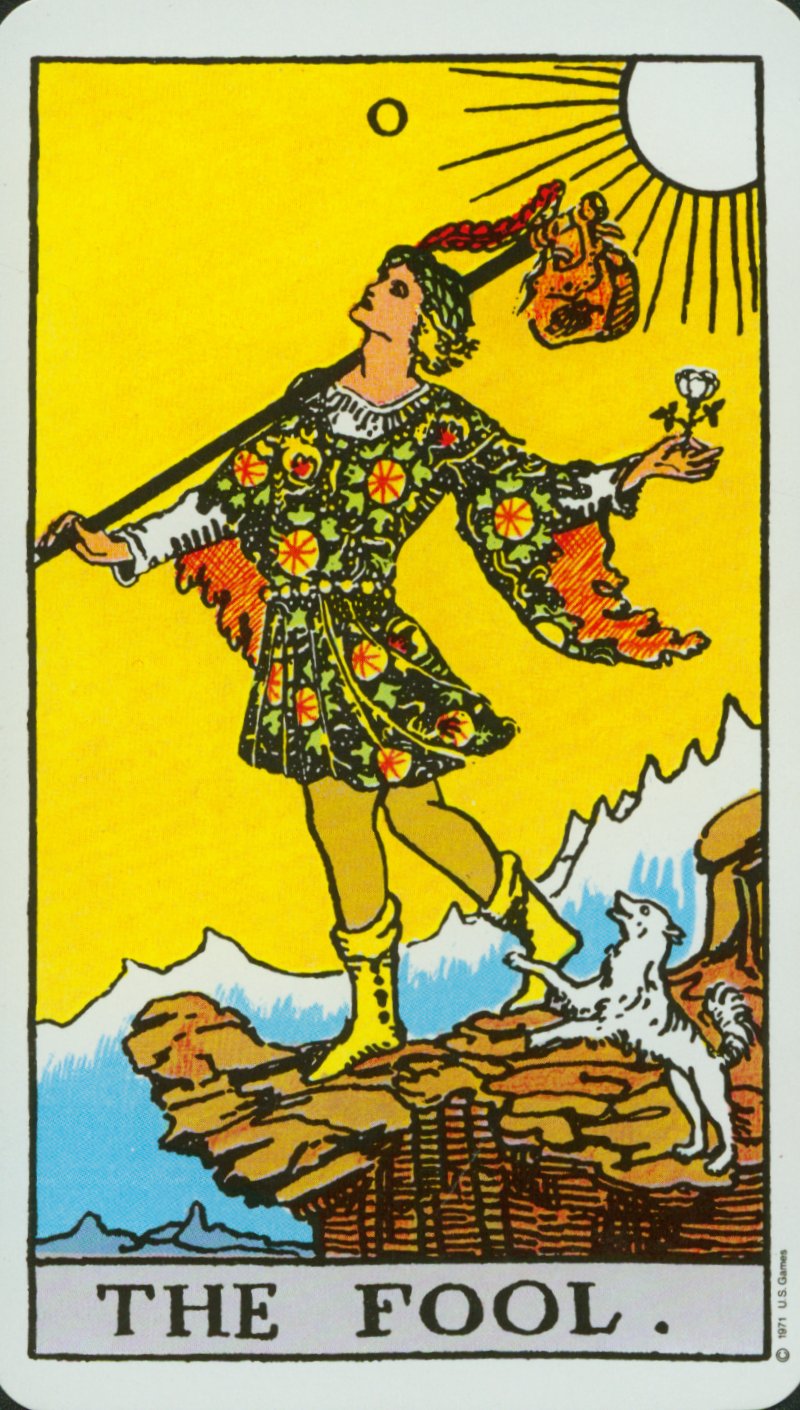
The Fool Tarot Card
What happens when someone hesitates at the edge of a cliff they thought they were ready to leap from? Write a scene, a memory, or a monologue from the moment just before the leap or the moment they turn back and realize the cliff wasn’t what it seemed. Remember, the Fool is the number 0, and contains all possibilities. Feel free to share what you’ve written. I’d love to read it.